Saturday, June 7, 2014

Rivers Contributing to Arctic Sea Ice Melt

I saw a very interesting paper in the journal Geophysical Research Letters about the MacKenzie River in Canada which empties into the Beaufort Sea and its affect on the melting of the Arctic sea ice, especially the massive 2012 ice melt. The waters in the river get warmed up and then empty into the sea, contributing to the sea warming and the ice melt. In 2012 this was complicated by a large ice dam that wasn't overwhelmed until 14 June. By 5 July, the authors found the surface temperature in the Beaufort Sea had increased by 6.5 degrees Celsius (about 11.5 degrees Fahrenheit) and the extent of open water occupied by warm waters had increased by 50%.

Their conclusion is that the MacKenzie and other large rivers bring large amounts of heat into the Arctic Ocean and contributes to melting sea ice.

So, what does that mean for today? Well, let's begin with the fact that Alaska and Siberia both had record warm winters. This means we could expect to see warm water flowing into the Arctic Ocean from those two regions. Canada had a cold winter, so the MacKenzie might not make much of a contribution in this regard this year. But, that a look at this data.

The graphic shown below is from the Polar Portal and shows the surface water temperature in the northern latitudes. This graphic shows the conditions on April 10 of this year. Notice the greenish area at about the 2:00 location. This is the discharge area of the Lena River, one of the largest rivers in the world. Notice how much warmer it is in that area than the surrounding areas. Also, note the greenish areas around the 4:00 position. This is the discharge area for the Ob and Yenisei Rivers. Again, note how it is warmer there. Now, using just this data here, we can't be sure about the Ob and Yenisei contributions. There are ways to explore that question, but not here. After all, that warming might be due to the Gulf Stream. But, that warming from the Lena River is very isolated and there is no discernible heat source that could be responsible for the warming except the river. In fact, if you were to follow this warming through the spring (I did), you would have seen the warming area spread outwards from the mouth of the river. That area is now mostly ice free.

An interesting point is to note the area around the mouth of the MacKenzie (about the 10:00 position) is not experiencing any above average warming. That is consistent with what I said above.

Source: Polar Portal
This bears watching. Right now, I would expect to see in coming weeks above average warming (and sea ice melting) in the area north of Siberia but average warming in the area north of western Canada.


Friday, June 6, 2014

Article on Democracy and Climate Change

I read an interesting article on CNBC about the role of our democratic government in addressing the issue of climate change. I thought I would share it. You can read the article here.

Climate Change Denial is the Moral Equivalent of Racism

On June 21, 1990,  a teenager in St. Paul, MN, identified only as R.A.V., burned a cross in the front yard of an African-American family. He was charged with violating the St. Paul Bias-Motivated Crime Ordinance which stated,

Whoever places on public or private property, a symbol, object, appellation, characterization or graffiti, including, but not limited to, a burning cross or Nazi swastika, which one knows or has reasonable grounds to know arouses anger, alarm or resentment in others on the basis of race, color, creed, religion or gender commits disorderly conduct and shall be guilty of a misdemeanor.
The teenager appealed the charge on the grounds that the law was an unconstitutional violation of his free speech rights. The case is known as R.A.V. vs City of St Paul. The Minnesota Supreme Court found in favor of St Paul and upheld the law. It was then appealed to the U.S. Supreme Court which struck down the law in a unanimous decision. Justice Scalia, writing the majority opinion, said,

Although the phrase in the ordinance, "arouses anger, alarm or resentment in others," has been limited by the Minnesota Supreme Court's construction to reach only those symbols or displays that amount to "fighting words," the remaining, unmodified terms make clear that the ordinance applies only to "fighting words" that insult, or provoke violence, "on the basis of race, color, creed, religion or gender." Displays containing abusive invective, no matter how vicious or severe, are permissible unless they are addressed to one of the specified disfavored topics. Those who wish to use "fighting words" in connection with other ideas — to express hostility, for example, on the basis of political affiliation, union membership, or homosexuality — are not covered. The First Amendment does not permit St. Paul to impose special prohibitions on those speakers who express views on disfavored subjects.

He concluded,

"Let there be no mistake about our belief that burning a cross in someone's front yard is reprehensible. But St. Paul has sufficient means at its disposal to prevent such behavior without adding the First Amendment to the fire."

What does this have to do with climate change? Nothing.

What does this have to do with climate change deniers? Plenty.

Climate change denial has reached the point of offensiveness that I now contend it is the moral equivalent of racial slurs. Racial slurs serve the purpose of denigrating someone based on some irrelevant basis, such as the color of their skin or their religious beliefs. There is no logic or factual basis to support the claims of people that use these slurs, although they will very vigorously claim there is. I cannot tell you how many racists I have listened to that have gone on about how one race is better than another one, or one religions is superior to another.

Yet, in this country, people are free to hold those opinions and to even voice them (with certain restrictions, most notably the 'fighting words' standard). So, if someone wants to go and use a slur in reference to some other person or group of people, they are free to do so. The words may be reprehensible, but they are free to use them.

However, everyone else is also free to condemn them for their words and even for their beliefs. We are free to label someone as a racist and to shun them from our society for their viewpoints. Part of the reason most of us find this kind of thought to be unacceptable is because we realize how illogical the thoughts are. The idea that all of the people in one race are superior to all of the people in another race, simply because of the color of their skin, is completely without any supporting evidence and intelligent people of any walk of life will recognize them as having no value and being offensive. Most people also recognize that, while it is healthy to allow free speech, the hate speech of racists is itself harmful to society.

The words of climate change deniers has now reached that same point. There is no logic or scientific evidence to support their claims and they are made merely for the sake of denigrating science.  In other words, what global warming deniers say about climate science is exactly parallel to what racists say about other races.

Pure and simple, climate change deniers are engaging in hate speech.

Just like in the case of R.A.V vs St Paul, their actions are reprehensible, but are allowed under the Constitution. However, we as a society have a responsibility to stand up to these hateful people and label them for what they are. It is healthy to allow that our Constitution allows them to say the things they do, but it is unhealthy for society to let them do it without condemning them.

I remember my grandmother telling me of how she had a separate set of glasses she used to take water and lemonade out to the help working in the yard. She kept these separate from the other glasses because, as she said, "No white person would ever drink out of a glass after a black man used it."

Where are you going to stand on the subject? And, how do you want your children and grandchildren to remember your stand?


Thursday, June 5, 2014

Deniers Only Want to Censor

One of the complaints deniers make is that they only want to engage in a debate and claim they are being shut out by the scientific community. I have always observed that this is not true and could give many examples to support that statement, but I'll give you just the most recent example. No, I'm not doing this to bash deniers. That is something I enjoy doing, but the purpose is to illustrate that the scientific community is more than willing to discuss the issues with anyone, including deniers. It is the deniers that are not interested in discussing the science. Their response is merely to censor anyone that supports their beliefs.

I was in a community on Google+ and a denier by the name of Cyrus Manz had this graphic on his posting:


Cute, but a completely false argument on the part of global warming deniers. I posted a comment about why it is a false argument. No one is claiming CO2 is a major part of the atmosphere, but at the same time it is well established science that a small amount of chemical can have effects far beyond its mass percentage. I made the analogy of pain killers and pointed out two Aleve tablets have a mass of 440 mg while I have a mass of about 88 kg. The two pain killers then have a mass that is about .0004% of my body mass, and yet that small amount of chemical can relieve my pain for 12 hours.

He replied:

Cyrus Manz
Your irrelevant parallel to describe the role of CO2 in climate temperatures is what's abjectly FALSE here my friend:-)
He also posted,

Please reference a single piece of scientific proof that explicitly places CO2 as the driver for global average temperatures.
P.s.
If you can't (which I am confident you can't) then you need to delete your own comment along with an apology, or you will be removed from this community.
Thank you.
So, already, he has shown that all he wants to do is censor any opposing statements that don't support his world viewpoint. I responded by providing a link to Skeptical Science that gives a very good discussion of CO2 in the atmosphere:


So, to be clear, Mr. Manz demanded that I provide 'a single piece of scientific proof' about the role of CO2 in the atmosphere, which I did. And that wasn't enough for him, or to more correct, it wasn't what he wanted to see. What he responded with was this:

Cyrus Manz
Our entire planet's atmosphere contains less than 0.04% CO2 (or Carbon Dioxide)....
Humans currently contribute an additional 0.002% to atmospheric CO2.
Come and see how you have been duped by climate change disinformation.
https ://plus.google.com/c ommunities/105386304 309909999553
I stated this was the what the fossil fuel funded denier industry wants people to believe. These are people that do not have our best interest at heart and only want to take our money. Why in the world should we believe anything they say?

His response?

Cyrus Manz
You clearly do not understand the [purpose of being a community member.
Goodbye troll.
At which point he disenrolled me from the community and spammed my comments.

So, where was the debate that Mr. Manz and other deniers keep claiming they want?

But, there is more to this story. This is an earlier comment Mr. Manz made on the same post:

Cyrus Manz
Yesterday 9:37 AM
No.
We know that there is not a single self respecting scientist that can claim to have scientific proof of man-made climate change.
But maybe you do. Let us hear it.
But, Mr. Manz, when a "self-respecting" scientist shows up to show you scientific proof you call him a 'troll' and censor him. So much for "Let us hear it."

One last comment. In case you think I'm misinterpreting things, this is the comment Mr. Manz made after banning me:

Cyrus Manz
We run the community for the sole purpose of advancing our cause, not theirs.
We engage in opposing discussions outside but the community provides a safe haven for us, free from trolls.
Notice the use of the term 'trolls' again. Anyone that doesn't subscribe to his world view is a 'troll' and is to be censored. While he isn't man enough to listen to the scientific evidence, at least he admits he's not man enough.

I'm sorry for Mr. Manz and anyone else that has fallen for the psedo-science of global warming denial. There is nothing I can do for them. They are lost minds and can't be saved. But, for those of you that haven't made up your mind yet and are wondering about what is going on, take a look at what was going on here with Mr. Manz and avoid shutting down your thought processes like this. If you want to be a denier that is your business, but at least don't stop thinking or listening.


Obama's New Coal Regulations

I've been holding off commenting on the new coal regulations announced by the EPA this past Monday. The reason is because the regulation has nothing to do with the reality of global warming. The science remains the same with, or without the proposed regulations.

However, I also like to discuss actions we can take to address the problems we are facing and the emission of greenhouse gases is certainly a problem that needs to be addressed. So, the question is, does the new proposed regulations address the problem? I have been reviewing what is being said and, to no surprise, both sides of the argument are making extreme predictions, neither of which seems to be holding up to the light of day.

First, I really see no evidence this will make a significant change in our greenhouse emissions. Headlines are saying it will reduce our emissions by 30%, but that isn't true. What it will do is cut emissions from new construction power plants by 30% compared to the 2005 levels. Power plants have already reduced emissions by about 13% compared to 2005 levels, so we are talking about an additional 17% reduction. These regulations apply only to new power plants and not to any existing power plants or other sources of greenhouse gas emissions, such as cars. In the total picture, that comes out to about a 6% cut. And, that is over a 15-year period. Notice that the 17% reduction occurred without any new EPA regulations. They occurred because of market forces, so it is reasonable to assume that further reductions would occur without these new regulations.

Also, it isn't even necessary to actually make the cuts. States can make their own plans and combine the power plants with something else. So, if some industry is making reductions anyway it is possible to combine them with the power plants and the power plants can then go their merry way. To make it even worse, states are allowed to join together in one big plan. So, the reduction could be taking place in one state and the coal-fired plant could be in another.

Based on that, I have to say this is getting a lot more attention than it deserves.

But, what about the draconian predictions of the groups opposed to the proposed regulations?

Again, I just don't see it. They are saying this will make electricity more expensive and cause a loss of hundreds of thousands of jobs. The US Chamber of Commerce is predicting a loss of 224,000 jobs PER YEAR for the next 15 years. That comes out to 3,360,000 total jobs and that number is just not credible on the surface. I would want to see some serious estimates before I accept a figure like that.

Why am I so critical of that estimate? Simple. The demand for electricity is sky-rocketing in this country. If we are not building coal-fired plants, we will build something else. The electrical utilities will find a way to supply the electricity demanded because that is what they are in business to do. Supplying electricity means profit. They are not going to sit back and allow potential profits to go away without doing something about it.

And, as it turns out, we are developing better ways to generate electricity than burning coal. Natural gas is not great, but it is much better than coal and we have a very serious boom in natural gas production going on in this country. We have the ability to replace all of the coal-fired plants with natural gas alone.

But, that isn't all. It now turns out that photo cells are becoming competitive with other forms of power production. A report by Barclays investment bank shows that photocells are already cost-competitive in Hawaii, and will be competitive in California by 2017 and New York and Arizona by 2018. By 2024, they say photocells will be cheaper than grid power in all but a handful of states.

Specifically, the report is looking at the issue of cells and storage on private homes - people going off the grid. But, if photocells are becoming that competitive, how long will it be before the utilities realize they can make efficient, competitive power plants using photocells?

In other words, we will be making electricity and I don't see the cost sky rocketing. As for the jobs, there will likely be some job displacement, but losses will probably be minor if in fact, we don't see an increase in jobs due to new technologies. Coal miners might see their jobs suffer, but I'm betting it won't be as much as is claimed. Coal is something of a miracle power source, other than the fact that it is a terrible polluter. You just dig it out of the ground and use it. You don't have to process it and it even comes in an easy to transport form. If we are not burning coal here in this country, there are world markets where it will still be cost effective to ship our coal. China alone is planning on opening a new power plant every week between now and 2050.

So, the way I view the regulation is that its pretty close to being much ado about nothing. The cost to the economy is not going to be anything like the dire forecasts being made. At the same time, the benefits to the environment are not going to be anything like the optimistic forecasts being made.

However, we must do something about the emissions. If this will help, then we should do it. And, it gives us the moral high ground to put pressure on other countries to take action on their emissions.

But, there is one dark side to this that needs to be addressed. As much as I, as a scientist, want to see politics stay out of a scientific issue, we all know that is not realistic. Politics is the driving force behind much of the debate. I really don't believe the Republicans would deny global warming evidence so strongly if it was being proposed by a Republican. And, what Obama has done with his actions is to stir the pot and alienate Republicans even more. By his failure as President to work with the representatives of the People, including members of his own party, he is making future progress even harder to attain. By acting as an Imperial President, Obama is making it increasingly difficult to convince skeptics that this is a problem that needs to be addressed now.

In summary, I think the regulation is good one, even though it is over-hyped. But, I denounce the way it is being done.

Wednesday, June 4, 2014

El Nino 2014

Update: You can read a nice NSF article on El Nino here.

There are many natural climate oscillations, but one of the most important is the El Nino/Southern Oscillation (ENSO).  El Nino is the ocean oscillation where Pacific waters get warmer than usual off the coast of Peru. NOAA defines El Nino as being when the Peruvian waters are at least half of a degree Celsius warmer than average for at least three months. The Southern Oscillation is the atmospheric oscillation that roughly accompanies the ocean component.

ENSO affects the weather virtually everywhere on the planet. It has caused droughts resulting in massive famines as well as widespread floods. The 1997-1998 El Nino caused the worldwide average temperature to rise more than 2.4 degrees Celsius (4.5 degrees Fahrenheit), making 1998 the hottest year ever recorded at the time. It is still the fourth hottest year on record and was so out of line with the rising temperature trend that global warming deniers continue to cherry pick it as the starting point for trend lines to claim there is no global warming. You can clearly see the isolated peak from 1998 in this graph of global surface temperatures.

http://www.giss.nasa.gov/research/news/20110113/509983main_adjusted_annual_temperature_anomalies_final.gif
Source: NASA Goddard Institute for Space Studies


So, it is small wonder that we keep a close eye on the formation of El Nino. The National Weather Service's Climate Prediction Center has a very detailed website with weekly updates on the ENSO conditions, and it is looking more and more likely that 2014 will be an El Nino year. I wrote the other day that El Nino is back. I am a little more lax in my definition of El Nino and jumped the gun in comparison to the official agencies. In fact, forecast centers around the world are saying El Nino, if it occurs, won't occur until later this summer or sometime in the fall. The consensus seems to be about 65% chance of it forming this summer and as much as 80% chance for it this fall. Forecasters are also saying it will be a mild to moderate event and nothing near as strong as some of the large events of the past. I have been reviewing the data and I agree with that assessment. There is a definite warming trend that has been going on this spring. The amount of warming that is being observed in the upper-level of the Pacific Ocean (upper-300 meters) is greater than the weak events of the past, but less than the strongest ones. That is not to say that something couldn't happen that would tip it to being either stronger or weaker. Such an event is certainly possible. But, based on past behavior, this event is proceeding in much the same way that past moderate events have.

What is still unknown is what effect global warming is having on ENSO. That will take some time to figure out.

Tuesday, June 3, 2014

Can We Trust Climate Scientists?

One of the claims deniers are now making is that we can't trust the climate scientist that are involved with global warming research. Their line of reasoning is that their grants and positions depend on finding evidence of global warming and they risk losing either, or both, if they ever find anything else. This, of course, is so ridiculous as to be funny, except there are people that believe this. So, let's examine this and see if there is any truth to the claim.

The basis, and motivation, for the claim comes from the fact that deniers are paid by the fossil fuel industry to discredit climate research. The funding is dependent on finding the results the fossil fuel industry wants. In other words, it is directed funding. This funding source greatly damages the credibility of the deniers, much to their chagrin. They can't get funding from any other source and are stuck with it. So, they respond by trying to paint authentic climate researchers with the same brush. If they are getting funding to find evidence of global warming, then we can't trust them, either. The irony of this argument is that they are themselves saying they can't be trusted. By making the claim that directed funding discredits you, they are admitting their own directed funding must discredit them. But, this posting is about the credibility of climate scientists, not the lack of credibility of the deniers.

The claim of the deniers depends on one thing - are the climate scientists being directed in their research? Do they receive funding to find evidence of global warming? Or, are they simply receiving funding to do research and let the chips fall where they may?  If this claim they are being directed is not true then we should be able to find research results that do not support climate change. This is actually pretty easy to do. Climate and weather are very complicated and not everything is going to lead to global warming.

A recent announcement from the National Science Foundation (NSF)  illustrates this. A researcher at the University of Michigan studied the effects of pollen on the climate and found something interesting. It had been thought pollen had little effect because it was such a large particle it would settle out. But, Dr. Allison Steiner and her team found that pollen particles actually break apart and become many small particles. These small particles lift water vapor up into the atmosphere where they assist in cloud formation. It this way, pollen actually works against global warming by providing a cooling effect.

By the way, Dr. Steiner gets her funding from the NSF. So much for being paid to find only proof of global warming.

Another example is some work done by scientists at Princeton University, the Australian Research Council Centre of Excellence for Climate System Science and the Australian University. They studied the way droughts are measured and they state there is an issue with the way droughts are measured. One of the beliefs about global warming is that the amount and severity of droughts worldwide will increase as the climate warms. The most common measure of drought, the Palmer Drought Severity Index (PDSI), has shown that this is actually happening. However, this team of scientists studied the PDSI and their conclusion (released in November 2012) is that this measure is in error because it was dependent on climatic conditions off the past. When they adjusted the measure to account for climatic changes due to global warming they found little change in the amount of drought over the last 60 years.

Again, credible scientists at reputable institutions finding results that do not support global warming.

This is the way science works. Researchers do the work and discover what the science says. If the science does not support what they believe, then they will change what they believe. The science is irrefutable.

The deniers fail in this manner. When the science does not support what they want to sell the public, they simply discard it and find a new false argument to try and persuade people to believe in what they want them to believe.

The claim that climate scientists are getting paid to prove global warming doesn't pass the credibility test. Climate scientists are paid to do climate research. There will be a climate with, or without, global warming. Their jobs do not depend on global warming and anyone thinking about this for even a few seconds will see that is true. If nothing else, we need a much more robust understanding of climate science for weather forecasting. That, by itself, is enough to justify all of the climate research being done and that would be true even if there were no such thing as global warming. The issue of global warming simply makes it that much more important.

Scientists are not motivated to find a specified result. They are motivated to find the correct result and to find it first. Honors go to the first, not the second. They do not give the Nobel Prize to runners-up. But, at the same time, by the scientific method, any scientific finding must be repeatable by anyone else. Scientists are not magicians and do not have special powers. They have special training and experience, but anyone with similar training and experience must be able to replicate their results. If only one person can do it, it isn't valid. If some scientist was to announce some kind of result and it couldn't be validated by other scientists the damage to that person's career can be devastating. Consider what happened to Pons and Fleishmann after their cold fusion announcement.

Finally, consider this. Much of the research on climate change was done during the administration of George W. Bush between 2001 and 2009. The Bush administration was openly hostile to climate change research and worked to suppress it. The irony is that, contrary to claims by the deniers, climate scientist were actually risking their careers by finding evidence of global warming, not the other way around.

What can we conclude? Can we trust climate scientists? The answer is that we can trust climate scientists to do valid scientific research in climate change and the science they produce is not directed by the funding source.

If only the deniers could make the same claim.


Monday, June 2, 2014

El Nino is back. What does it mean?


El Nino is the name given to the natural cycle that involves the eastern Pacific getting warmer in the area close to the equator. (La Nina is the name for the alternative cycle when the waters there are cooler. The two together are known as the El Nino Southern Oscillation - ENSO.) This is one of the most significant natural cycles and occurs every few years. It has the potential to change weather around the world. Take a look at this graphic showing the sea surface temperature anomaly. The darker the red, the warmer it is relative to the long-term average.

Source: Climate Reanalyzer
You can clearly see how the water temperature off western South America is warmer than usual, which is the classic definition of El Nino. The name comes from how local fishermen noticed the change  in the water and how it seemed to always arrive in the late fall - about Christmas time. El Nino means 'the boy' and refers to the Christ child of Christmas. The name has stuck.

But, the important thing is to notice how the warm water stretches all the way across the Pacific Ocean. The significance of this lies in the fact that warm water creates atmospheric low-pressure areas which results in thunderstorms. There is now a Pacific Ocean-wide corridor of low pressure which will allow thunderstorms to develop and travel all the way from Asia to South America. One of the things this leads to is a change in the Hadley Cells.

Hadley Cells are circulation patterns in the atmosphere. Warm air near the equator rises and then travels towards the poles at high altitude. When the air reaches the mid-latitudes it sinks back to the surface and travels back towards the equator. This circulates heat and causes the trade winds. A stronger El Nino results in stronger Hadley Cells. Live Science has a nice graphic here showing how this all works.

You can probably see where this is going. More heat is being circulated through-out the world as a result of El Nino. Changes in the heat and water vapor input in a given region will result in changes to the weather in that region. How much of a change and what kind can be expected? That is a big variable. Some regions will experience greater rainfall. Others will experience droughts. Depending on the strength of the El Nino event, the effect could be anywhere from very mild to catastrophic.

Some of the most dramatic example of El Nino effects is a series of famines that have occurred in what is modern-day India, including the Great Famine of 1876-1878 (5.5 estimated dead) and the Bengal Famine of 1770 (10 million estimated dead). These famines occurred when the monsoons did not occur and the crops failed. The famines were greatly aggravated by British mismanagement.

What has been found is that severe droughts in India always occur during El Ninos, but not every El Nino leads to droughts in India. The apparent link seems to be where the Pacific is warmest. When it is warmer in the Central Pacific, India has droughts. When it is warmest in the Eastern Pacific, India is spared. Take a look at the plot of surface temperatures, similar to the plot above.

Source: Climate Reanalyzer

The figure above showed the difference from the average. This plot shows the actual average temperature. The way I interpret this data is that it is warmer in the Central Pacific region than in the Eastern Pacific region off of South America. This could be bad news for India. The good news is that Britain is not handling the management any more.

But, El Ninos are not bad news for everyone. Actually, for us in the U.S. it will be a good thing. A typical El Nino brings mild temperatures and more rainfall for the southern half of the country. This would be particularly welcome in the mid-Plains and the Southwest where drought has been raging for many years. In fact, several states out here are at risk of running out of water.  More rain would be good.

So, let's talk about the White Elephant sitting in the middle of the room. Is global warming affecting the ENSO cycle? Quite simply, we don't know yet. There are some that believe a connection exists, but more data is needed. What is known for sure though, is the El Nino affects the short-term accuracy of our computer models. The models are highly accurate when predictable conditions exist. But, unpredictable events like ENSO and volcanic eruptions disrupt them. The good news is that when the events occur and are included in the models, the models once again become highly accurate - in excess of 95% accurate and getting better. I have not heard what the models are forecasting with the this current El Nino included, but I will keep a look out for any news.

Sunday, June 1, 2014

"New Ice Age" Journalist Speaks Out

The climate change deniers love to roll out false arguments to fool the public. To give them credit, they are very good at doing this and their campaign has been very successful due to their skills. One of their favorite false arguments is that scientists in the 1970s were predicting a new ice age. The deniers pull this out with the claim that scientists were wrong then, so they could be wrong now. Not only is this completely false, but since they know its false, it makes it a lie every time they say it. This issue has been examined in detail and you can see the details here.

But, for the sake of convenience, let me recap. Some climate scientists came to the conclusion that we might be entering a cooling trend in the 1970s and the planet could experience some long-term cooling in the years to follow. Notice, cooling trend and long-term cooling are not the same as an imminent ice age. However, Peter Gwynn, a writer with Newsweek, wrote a 16-paragraph article that ended up as the cover story for that week's edition of Newsweek. This article was then picked up by other news media and repeated. An imminent ice age was not the scientific consensus, rather something the news media reported.

A reading of the article is quite interesting. For one thing, it wasn't all that wrong. Look at this plot of temperatures since 1900. There is a definite upward trend in the first half of the 20th century, followed by a pronounced downward trend from the late 1940s through about 1970. The climate scientists of the 1970s were right, the worldwide temperature was falling.


Source: Skeptical Science

This also highlights another false claim of the deniers, the one where they state that the climate goes through cycles. The obvious implication of that statement is since the climate goes through cycles, we are just in a naturally occurring warming cycle. The fact is, the climate actually does go through natural cycles, but we are in a naturally occurring cooling cycle right now. Imagine how much hotter it would be if we were in a natural warming cycle. Of course, we don't know when this current cooling cycle will end. Stand by for some real good times when that happens.

But, now, the author of that article is speaking out. Peter Gwynn wrote an article where he discusses his original article and what has happened since then. To his credit, Mr. Gwynn takes responsibility for any misrepresentation he might have made and states,

Speaking personally, though, I accept that I didn't tell the full story back then. Indeed, the issue raises questions about the relationship between science writers and scientists as well as the attitudes toward science of individuals with political agendas.
He also states later in the article,

Here I must admit mea culpa. In retrospect, I was over-enthusiastic in parts of my Newsweek article. Thus, I suggested a connection between the purported global cooling and increases in tornado activity that was unjustified by climate science. I also predicted a forthcoming impact of global cooling on the world's food production that had scant research to back it.

But, I can't blame Mr. Gwynn too much and he gives the very reason why. The science at the time was poorly formed. Today, climate science has progressed with remarkable advances. Our understanding of the climate, how it works and what it was like in the past is dramatically different today than it was 40 years ago. There has really been a staggering amount of progress in this regard. Mr. Gwynn was writing in the 1970s and had to write about what was known in the 1970s. He was not at fault for our lack of understanding. I do think, though, that he over represented what the scientific consensus of the day was (see the Skeptical Science link above).

Mr. Gwynn also had a comment in the conclusion that was right on the money,
Climatologist are pessimistic political leaders will take any positive action to compensate for the climatic change, or to even allay its effects.

That, of course, is precisely the situation we are currently in and the fossil fuel industry is spending hundreds of millions of dollars to prevent anything from being done.


Our understanding of climate science can be compared to our understanding of cancer. Are there things about cancer we don't understand? Yes, you bet there are. Should we throw out all oncologists because of that? No. If you or someone you love has cancer are you going to ignore the doctors and do your own thing? Some people do. Ask Steve Jobs how well that worked out. Oh, yeah. You can't because he's dead. Maybe if he had listened to the oncologists (who still don't understand everything) instead of trying some kind of 'alternative' treatment, that wouldn't be the case. The fact that we don't know everything does not mean we know nothing.

The same is true for climate science. Do we know everything? Not even close. Should we throw out all of the climate science because the fossil fuel industry finds it troubling? No, not ever. What the deniers want us to do is the equivalent of what Steve Jobs did. Our understanding of climate science has progressed enormously and we understand it much better than ever before. All we are going to do from here on out is to improve our understanding, not throw out what we have already figured out.

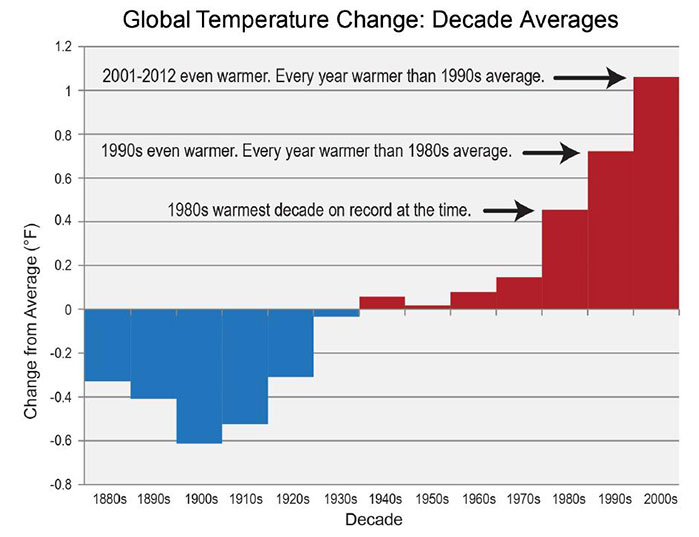
Ultimately, the climate is warming and we are going to have to do something about it. Take a look at this figure from NASA and the National Climate Assessment.

http://www.insidescience.org/sites/default/files/graph-of-change_0.jpg